
Upcoming Shows
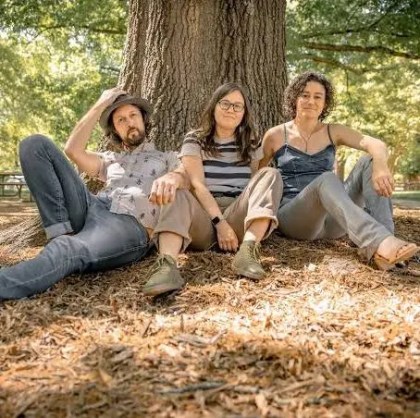
Stillhouse Junkies is an American roots, bluegrass, and Americana trio formed in 2017 and based in Durango, Colorado. Known for high-energy improvisation and genre-blending original music, the group won the International Bluegrass Music Association (IBMA) Momentum Band of the Year award in 2021
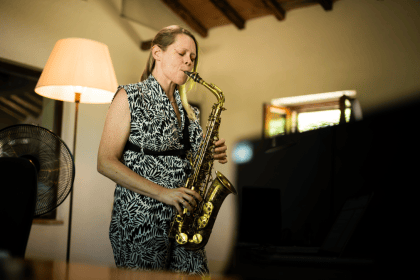
Caroline Davis is a Brooklyn-based saxophonist, composer, and activist, whose work is driven by a desire for connection and a belief in music’s capacity to expand listeners’ ears, minds, and hearts. A 2025 Guggenheim Fellow in Composition, she is the recipient of the DownBeat Critics Poll Alto Saxophone Rising Star Award, as well as fellowships from NYFA, the Jerome Foundation, Chamber Music America, and the Foundation for Contemporary Arts. Her residencies include MacDowell, The Jazz Gallery, Civitella, and the Rockefeller Estate, and she has served as a mentor for New Music USA’s Next Jazz Legacy program.
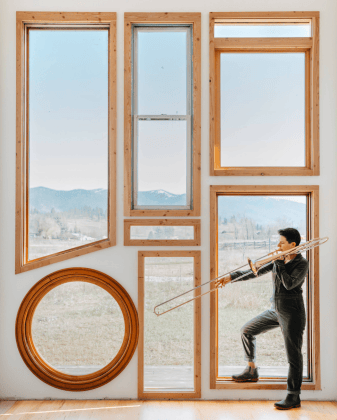
Trombonist, improviser, composer, and educator Naomi Moon Siegel is committed to creating a positive, transformative music culture beyond conventional genre norms. Her musical vocabulary draws on the richness of a variety of global musical traditions including Black American Music and the sonorities of the natural world. Siegel explores the trombone as a vehicle for sonic expression colored by breath, spit, space, and physicality. Now based in Seattle, Naomi returns to Missoula for this intimate solo appearance in support of Caroline Davis.
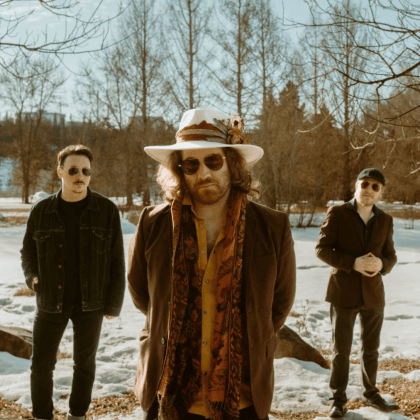
This is a new group to Longstaff House, but I think you will like them. They will rock the place a bit. Have a listen: https://www.johnhewittmusic.com/
John Hewitt is one of Western Canada’s most prolific artists. Celebrating the release of his 10th album with his backing band the New Americans on a 60 date fall tour spanning four provinces and 6 states. A child of the sounds of the 60’s and 70’s this group brings a quality in performance not seen since the 1970’s with three part harmony, melodic hooks, poetic lyrics and the best of Americana amalgamated into one powerhouse trio. Join John Hewitt, Benjamin Williams and Connor Miskiman on their Far-West Tour 2026.

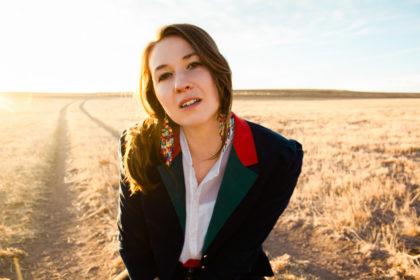
Lena and Ro will be sharing the stage at Longstaff House Lena will be playing as a duo and Ro as a trio.
A year ago, driving late one night, singer/songwriter Lena Rich watched an emerald city materialize from the delirious haze of long miles on the road. As she sped nearer, the mirage faded into an oil refinery glowing sickly green in the darkness. Yet that liminal moment between imagination and reality lingered in Rich’s mind, and eventually became the guiding concept and title track for her latest album, Emerald City. Written mostly while on a tour that began the day after Rich’s partner and collaborator at the time broke things off, Emerald City (September 4) is a series of stories about finding your footing, composed as Rich was finding hers. Quickly discovering the collaboration had only been holding her back, Rich steeled herself and set out on the road alone, instead of folding. And as she gained solid ground day by day, she surprised herself with a new vulnerability, deeper connection to audiences, and a newfound creativity that flourished.
Nowhere, Nebraska, Myra’s extraordinary debut, is more than just a musical homecoming, though. Recorded over the last few years in Denver, Nashville, and Austin, the album is a complex reckoning with the past, a nuanced, literate reexamination of small-town life in the shadow of heartbreak, self-destruction, and second chances. While the arrangements here are broad and sweeping, Myra’s storytelling is sharply focused and firmly rooted, offering up rich, detailed character studies with keen insight and deep empathy. She writes with a novelist’s eye, isolating moments and emotions with surgical precision, and she sings with a weathered grace that makes the hard truths go down easy. The result is a warm embrace of an album all about memory and forgiveness, growth and pain, freedom and fate, a collection that calls to mind everything from Lucinda Williams to Bruce Springsteen to Lori McKenna to Brandi Carlile to Sheryl Crow as it makes peace with the past in order to more fully inhabit the present
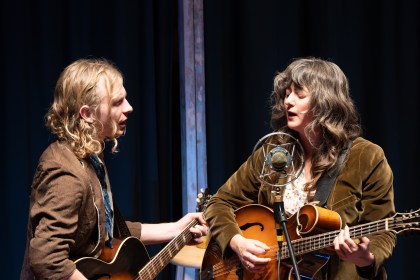
Joy has been here with Darol Anger, Half Pelican, and Big Richard, and now has a new recording with Gus Tritsch. Everything she touches is golden, don’t miss this.
Peddling their new duo album, Anything Lovely, here come Joy Adams and Gus Tritsch from Colorado. Joy, also a member of Big Richard, has appeared on the Late Show with Stephen Colbert, NPR’s Tiny Desk, Red Rocks, and the Grammy and Emmy award winning film scores to The Queen’s Gambit and Godless on Netflix. Gus has toured internationally with Jake Blount, played at the Kennedy Center and NPR’s Tiny Desk, and tours with his band The Wild Shoats.
Both make music that is introspective and raw in its search for connection, found through songs and gritty fiddle tunes that are both old and new and maybe neither. Together, the two blend their voices and varied influences in a diverse collection of original songs and oldtime music.

We are getting a steel pan band at Longstaff House. They will be in town for a concert at UM and do a house show here. Read the bio and listen to the Tiny Desk show with Bela Fleck )sorry, not coming with).
JONATHAN SCALES FOURCHESTRA – BIOYou’ve heard this before, but the whimsically named Jonathan Scales Fourchestra is really tough to describe. Veering from in-your-face, jaw dropping chops and passion, to those quiet moments when the background noise disappears and you hold your breath to take in a soundscape of solitude, the power trio of electric bass (E’Lon JD), drums (Maison Guidry), and steel pans (Jonathan Scales) combines elements of jazz, classical, and progressive rock, peppered with Latin rhythms and soulful outbursts of funk. From club and festival stages across North America and Europe, and tours of Africa, Southeast and Central Asia as a Cultural Ambassador for the US Department of State, to their NPR Tiny Desk Concert featuring Béla Fleck, the Fourchestra’s live shows make even the most jaded listeners forget where they are… even if just for a precious moment.
This may seem an odd thing to say, but on the verge of releasing their eighth studio recording, Jonathan Scales Fourchestra is only now truly embracing their identity as a group. For many years, Jonathan’s live band was a fluid lineup of top-notch musicians, and even included an “all-star” version with bassist MonoNeon (Prince, Nas), drummer Sput Searight (Snarky Puppy, Snoop Dogg) and percussionist Weedie Braimah (Trombone Shorty, Christian Scott aTunde Adjuah), as well as a number of other marquee players. Now, however, the Fourchestra is a decidedly indivisible band, and Jonathan is writing for the trio, not just the pans.